Showing posts with label No Dram of Mercy. Show all posts

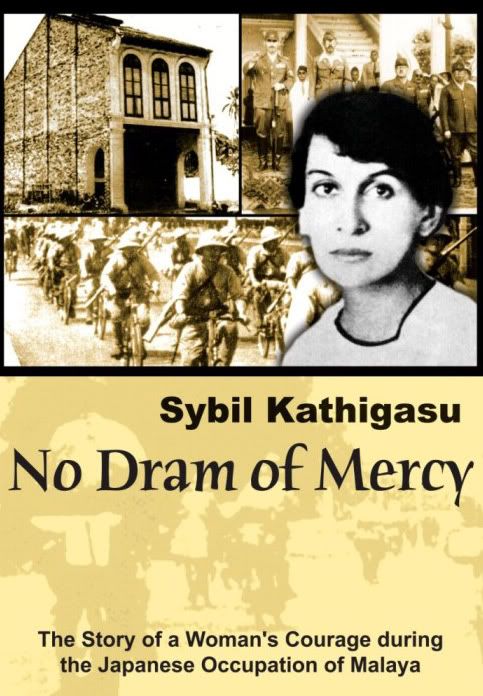
No Dram of Mercy by Kathigasu

Title: No Dram of Mercy

Author: Sybil Kathigasu

List Price: RM 28

Pages: 201 (148mm X 216mm)

Published in 2024 

by Prometheus Enterprise, Kuala Lumpur, Malaysia

ISBN 983-2197-38-6


New Edition: with book Review from Dr. Wong Soak Koon 


About the Book 

No Dram of Mercy is one woman's memoir of her struggles during the Japanese occupation of Malaya, when she and her doctor husband were arrested for secretly helping resistance fighters. 

    Sybil Kathigasu candidly describes her experiences, from the practicalities of daily life to the constant fear of discovery and her harrowing ordeal at the hands of the Kempetei military police.

   A devout Catholic, she had pledged to write a book about those years if she survived. The result is a vivid account not only of the horrors of the Japanese occupation, but also of one woman's courage and fortitude in the face of cruel and ruthless invaders.   

    Republished after seven decades, No Dram of Mercy is a testament to Sybil's indomitable spirit and devotion to the fight for freedom from oppression. It is also a poignant reminder of the hardships and tribulations endured by an earlier generation of Malayans during World War II.


About the Author

Sybil Kathigasu, née Daly, was born in 1899 in Medan, Sumatra, to a Eurasian family. Trained as a nurse and midwife, she married A.C. Kathigasu, a Tamil doctor, while working at the Kuala Lumpur General Hospital.

    The couple ran a clinic in Ipoh from 1926, but moved to Papan in 1941 due to the Japanese invasion. In Papan, they provided medical care to the poor, and quietly treated ill and injured anti-Japanese guerillas. As a result, they were arrested in 1943, tortured and imprisoned in brutal conditions.
   After the war ended in 1945, Sybil Kathigasu was sent to London for treatment of her severe injuries. She was awarded the George Medal for her bravery, but died months later in 1948, aged 49. 

    Initially buried in Scotland, her remains were returned to Ipoh in 1949 and interred at St. Michael's Church Cemetery. As a tribute to her sacrifice, a street in Ipoh was named Jalan Sybil Kathigasu. In 2016, Google issued a doodle in honour of “her tireless dedication to freedom”.


Remembering one woman’s courage

  • Review by OOI SI MUN
I WONDER how many people of my generation (I’m 39), or the next, know of Sybil Kathigasu? I certainly don’t recall learning about her in school or from my peers. Older relatives, in their re-telling of wartime suffering, did not mention her name.

Had I not picked up a reprint of her memoirs entitled No Dram of Mercy, I’d probably remain ignorant of Kathigasu, recipient of the George Medal, “the highest British civilian award for bravery”.

Kathigasu was unabashedly pro-British (a sample: “I reminded the guard of what Malaya owed to Britain, and of the amount of talent, labour, money and material which had gone to make Malaya the happiest and most advanced country in the East.”), but this Eurasian lady also had pride as a Malayan and did the utmost to assist her fellow nationals, particularly in the town of Papan, Perak.

Against the backdrop of the Japanese invasion and occupation of Malaya, Kathigasu, whose husband was a doctor, provided medical aid to the civilian population of all races, and to members of the Malayan People’s Anti-Japanese Army (MPAJA).

Her tenacious character is first revealed in her refusal to join the British withdrawal to Singapore. Then there’s her persistence in tuning in to radios (instead of turning them in) for news from the free world. Her perilous aid to MPAJA guerrillas finally led to her betrayal and incarceration by the dreaded Kempetei (Japanese secret police).

In No Dram, the author does not wallow in self-pity, choosing not to dwell on personal suffering but telling of beatings and torture in an almost matter-of-fact way:
“The places on which the blows were concentrated were those containing no vital nerve or organ so that no permanent injury resulted to the victim ? these parts of my body were soon solid bruises.”
That which apparently mattered more to her was the well being of her loved ones, including her five-year old child, Dawn, who was strung up a tree and threatened with immolation by Kathigasu’s sadistic interrogator, Sergeant Yoshimura.

Kathigasu’s selflessness can best be summed up in her own words:
“The thought (of death) did not disturb me ? and I had the consolation of knowing that my family would be safe, and that I had successfully resisted all attempts to wring from me information about the guerrillas and their contacts.”
Her sudden demise not long after liberation casts a shadow on her otherwise triumphant story, and, unfortunately, we learn not of the fate of several important characters in her book.

These include Moru, her link with the guerrillas; Chen Yen of the MPAJA; and Dr A.C. Kathigasu, her husband.

With so little in evidence today of Sybil Kathigasu’s grit and sacrifice, No Dram of Mercy serves as reminder (or introduction, for those of my generation, perhaps) of a woman who survived terrible odds with only her unwavering faith in justice and in God, and of a time when Malayans of all races persevered in the face of adversity.

Sunday March 25, 2007

History Revisited

Stories by SHEELA CHANDRAN

The heroism of a sympathiser of Malayan resistance fighters is immortalised in a drama mini-series and a documentary.
    THE heroic deeds of Sybil Kathigasu are chronicled in the new instalment of Suatu Ketika, the TV series on Astro that showcases historical legends and personalities who had impacted the nation’s development.
    Did you say Sybil who? If you did, you are not alone. A majority of Malaysians are unaware of the contributions of the World War II heroine, who has largely been forgotten or reduced to a footnote in local history books.
    All that will change when two TV programmes put the spotlight on Sybil Kathigasu, her sacrifices and sufferings during the Japanese Occupation.
    Those in the know will remember Sybil as the nurse-midwife who, together with her husband Dr A.C. Kathigasu, risked their lives to secretly provide medical service and intelligence to the resistance fighters of the Malayan People’s Against Japanese Army.
   Born in Medan, Indonesia, in 1899, Sybil Daly – the daughter of an Irish planter and an Indian woman – grew up in Malaya. She would later run a clinic from a shoplot in small-town Papan in Perak with her husband.
   During the war between 1941 and 1945, the Eurasian Malayan endured unimaginable torture under the hands of Japanese soldiers. Her fingernails were ripped off with pliers and her legs scalded with iron rods. She was also forced to drink large quantities of water before the Kempeitai (Japanese military police) stepped on her bloated stomach. She suffered damage to her spine and skull after a severe beating by thick bamboo sticks.
    None perhaps was more torturous than witnessing her six-year-old daughter, Dawn (the younger of two girls), being hung from a tree over a fire.
    Sybil also owned the town’s only radio set, nicknamed Josephine. Through it she listened to broadcasts from Britain and the outside world, and told the news to the townsfolk. Because of her “subversive” activities, Sybil and her husband were arrested by the Kempeitai, brutally tortured and detained at the Batu Gajah prison until the war was over.
    After Malaya’s liberation from the Japanese in 1945, Sybil was flown to England for medical treatment. In 1948, she became the only Malayan woman to receive the George Medal for Gallantry, a high civilian honour given by Britain’s King George VI.
    Several months later, Sybil died aged 49 in Britain. An old wound on the jaw sustained from the kick of a Japanese boot had brought on a fatal bout of septicaemia. Her body was later brought back to be buried at the St Michael’s Church in Ipoh, Perak.
    The indomitable Sybil had penned her memoirs in the book No Dram Of Mercy, which was published posthumously (in 1954). In it are accounts of her 1943 imprisonment and the ideals that shaped her life.  ..... 
The Star Sunday May 2, 2010

No Dram of Mercy by Kathigasu

Title: No Dram of Mercy
Author: Sybil Kathigasu
Price: RM 22 (W. Malaysia) S$13 (Singapore)
Pages: 185
Published in 2006 by Prometheus Enterprise, Kuala Lumpur, Malaysia
ISBN 983-2197-22-8

No Dram of Mercy is the story of a woman’s courage, told simply and unassumingly in her own words. Sybil Kathigasu was the wife of an lpoh doctor who along with her fellow Malayans became caught up in the horrors of the Japanese occupation of Malaya during the Second World War. Her selfless concern for the sick and wounded anti-Japanese guerillas who came to her house secretly for treatment ended inevitably in her betrayal and her arrest and imprisonment by the Japanese authorities.

The tale of fortitude and endurance under duress and torture which follows is testimony not so much to the ruthlessness of a conqueror as to the indomitability of the human spirit informed by faith and belief in God. As such, the story of Sybil Kathigasu, reprinted here after a lapse of five decades (first published in 1954), is a tract for our times as much as it is a reminder of the tribulations experienced by a former generation of Malayans.

《悲悯阙如》/ Kathigasu著

书名: 悲悯阙如
原著: No Dram of Mercy (1954年初版)
作者: Sybil Kathigasu(西碧儿·卡迪卡素)
译者: 陈文煌(笔名沙禽)

系列: 方志丛书 2
定价: 马币
RM 20 / 页数: 169
出版: 吉隆坡 燧人氏事业,2005年

ISBN 983-2197-20-1内容简介:《悲悯阙如》是一位坚强女性扶危济困、挺身抗暴的回忆录。作者是马来亚霹雳州怡保市一位医生的妻子,在日军占领马来亚时期的乱世中见义勇为,医治和协助抗日游击队员,直到她连同丈夫都因此被拘捕。在酷刑与胁迫下,她饱受折磨但仍然坚贞不屈。
  书中的血泪故事,不仅见证了上代人的多灾多难及侵略者的无情无义,更体现了人类精神中的不屈不挠、无私无畏。正如谢文庆教授所评,Sybil Kathigasu 的事迹,是“一位勇敢的女性为伸张人性、正义和理性的奋斗”,“代表了反抗压迫和反抗不义的精神”。